
🌿 othersEasy to use
Alum
Ancient EgyptianYear aroundDistinctively astringent, acidic, and sweetish taste
Did You Know?
Alum has some truly "strange but true" history. Beyond the kitchen and the bathroom cabinet, it has played a role in everything from ancient warfare to high-stakes industrial espionage.1. The Secret Weapon of Ancient WarfareIn ancient times, alum was used as a fire retardant. Siege engines and wooden towers were often coated with a mixture of alum and vinegar or clay to protect them from flaming arrows. It was essentially the world's first "fireproof paint."2. It Was Once a "Royal Monopoly"In the 15th century, alum was so vital for the textile industry (to make dyes stick to fabric) that it caused a massive political scandal. When a huge deposit was found in Italy, the Pope declared a monopoly on it. Anyone who tried to smuggle alum from "infidel" lands (like the Ottoman Empire) risked excommunication!3. The "Alum War" of 1472There was actually a war fought over this mineral. The city of Volterra in Tuscany rebelled against Florentine rule over the rights to a local alum mine. Lorenzo de' Medici (the "Magnificent") sent an army to crush the rebellion specifically to secure the "Alum of Volterra."4. The "Magic" Blood-StopperIf you look at a Styptic Pencil used by barbers, it is almost 100% alum. It works through a process called flocculation, where it causes the proteins in your blood to clump together and seal the wound instantly. It’s like "instant scab" in a stick.5. It Can Grow "Giant Diamonds"Alum is a favorite for science experiments because its molecules arrange themselves into perfect octahedrons (eight-sided crystals). If you suspend a small "seed" crystal of alum in a saturated solution, you can grow a "giant diamond" that looks incredibly realistic—though it will dissolve if you drop it in water!
Overview
Ancient Egyptian · Year around · others
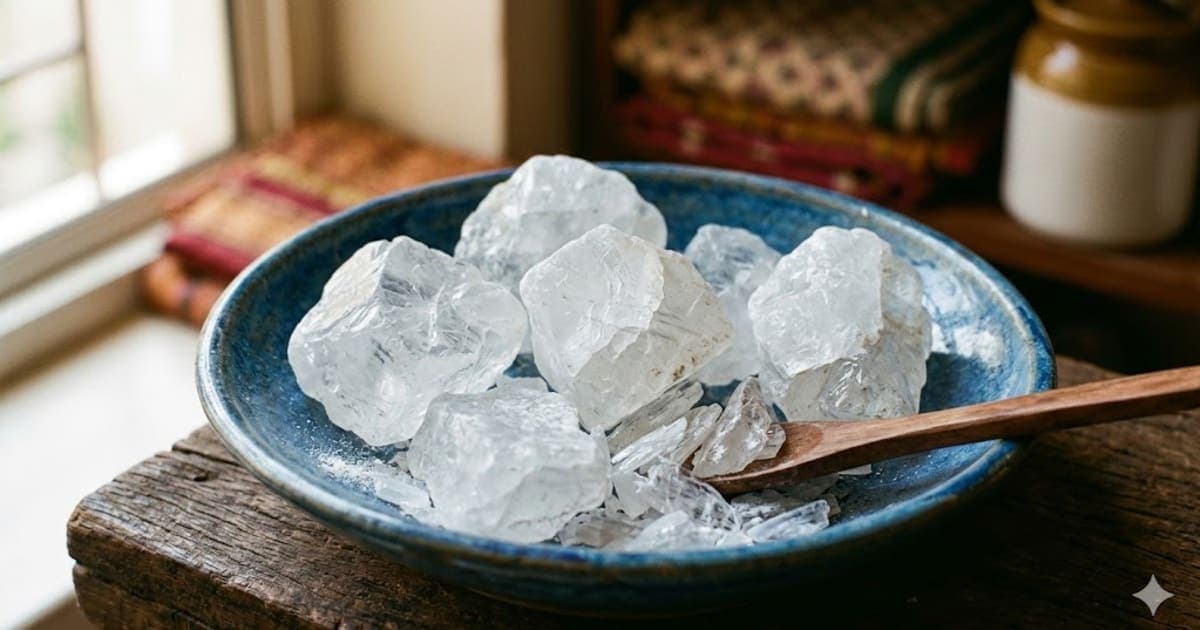
Alum (Potassium Alum) is a fascinating mineral. While many people recognize it as a "shaving stone" or a pickling agent, it is actually a versatile chemical compound used across culinary, medicinal, and industrial fields.lum usually refers to Potassium Aluminum Sulfate. It is a colorless, odorless crystalline substance with a distinctively astringent, acidic, and sweetish taste. It has been used since antiquity from ancient Egyptian dye processes to medieval medicinal applications.
Ancient Egyptian
Origin
Year around
Season
Easy
Difficulty
others
Category
Flavor Profile
Distinctively astringentacidicand sweetish taste
Storage Tips
Properly storing alum is simple, but because it is a mineral salt, it has a few specific "enemies" mainly moisture and confusion with other white powders (like sugar or salt).Here is how to keep your alum shelf stable for years.1. The "Airtight" EssentialAlum is hygroscopic, meaning it pulls moisture directly out of the air.The Risk: If left in an open bag, it will turn into a hard, rocky clump that is nearly impossible to measure.The Fix: Store it in a glass jar with a rubber seal or a high quality plastic container with a screw-top lid. Avoid simple "zip top" bags, as they often leak air over time.2. Environment Matters.Temperature: Keep it in a cool, dark place like a pantry or a low cabinet. While heat doesn't chemically "spoil" alum, extreme temperature swings can cause condensation inside the jar, leading to clumping.Light: While light doesn't degrade alum as it does with spices or oils, keeping it in a dark spot prevents the container from heating up.3. The "Safety Label" RuleThis is the most critical storage tip for home safety.The Danger: Alum looks exactly like granulated sugar or fine sea salt. Ingesting a large amount of alum by mistake can cause severe vomiting or worse.The Fix: Always label the container in bold, clear letters. If you have children in the house, store it on a higher shelf or in a separate "non food" section of your pantry to prevent a dangerous mix up.4. Keep it Away from MetalsThe Tip: Do not store a measuring spoon inside the alum jar if the spoon is made of reactive metal (like cheap aluminum or copper).The Reason: Over months, the acidic nature of the alum can cause minor corrosion on the metal, which may discolor the powder. Use a plastic or stainless steel scoop instead.5. Separation of UsesIf you use alum for both pickling and grooming (as a deodorant or aftershave):Keep two separate containers.Cross-contamination from bathroom humidity or skin oils can ruin the purity of the alum you intend to use for food.Storage Summary TableFactorIdeal ConditionWhy?ContainerAirtight Glass/PlasticPrevents moisture absorption.LocationCool, Dry PantryStops clumping and "caking."LabelingHigh Visibility/WarningPrevents accidental ingestion.Shelf LifeIndefinite (Years)It is a stable mineral that doesn't "expire."
Photo Gallery
How to Cook with Alum
Recipes, pairings, substitutes, and professional tips
Cooking Tips
While alum is a traditional ingredient, modern cooking treats it with caution. Because it is an astringent and a chemical compound, "cooking" with it is more about processing than seasoning.Here are the essential cooking tips for using alum safely and effectively.1. The "Golden Rule": Rinse, Rinse, RinseThe most important tip for using alum in food is that it should never stay in the final product.The Process: Alum is typically used in a "pre soak." You soak your vegetables (like cucumbers or cherries) in an alum water solution to firm up their cell walls.The Tip: After the soak, you must rinse the vegetables multiple times in cold, clear water. If you don't, the pickles will have a bitter, metallic, and "puckery" astringent taste that ruins the flavor.2. Precision is CriticalAlum is powerful; more is definitely not better.The Ratio: Use no more than 1/4 teaspoon per quart (approx. 1 liter) of pickling solution.The Risk: If you over-use alum, it can actually have the opposite effect making the pickles soft or giving them a chemically "off" flavor. In large amounts, it is also toxic.3. Avoid Metal CookwareAlum is acidic and can react with certain metals.The Tip: Always use glass, high quality stainless steel, or ceramic bowls and pots when soaking or boiling with alum.The Reason: Using reactive metals like "raw" aluminum or copper can cause a chemical reaction that discolors your food or leaches metallic toxins into your brine.4. Use for "Long-Process" OnlyBest for: Fermented or "7-day" pickles that sit for a long time. Alum helps these maintain their structure over weeks of processing.Avoid for: "Quick pickles" or "Refrigerator pickles." For these, the alum doesn't have enough time to work effectively, and you are better off using ice-water soaks or calcium chloride (often sold as "Pickle Crisp") which is much safer and easier to use.5. Safety FirstLabeling: If you store alum in your pantry, label it clearly "NOT FOR DIRECT CONSUMPTION." It looks identical to salt or sugar, but a spoonful can cause severe digestive distress or vomiting.Substitution: If you are hesitant about using a chemical mineral, Grape Leaves are a natural alternative. They contain tannins that achieve a similar "crunch" without the chemical risks.Quick Conversion Table for PicklingBatch SizeAlum AmountPurpose1 Quart1/8 to 1/4 tspFirming agent for cucumbers1 Gallon1/2 to 1 tspLarge batch soakingSubstitution1 Grape LeafNatural tannin firming
Substitutes
Since alum is primarily used for its astringent (firming) or leavening (rising) properties, the best substitute depends entirely on what you are trying to achieve.Here are the most effective substitutes for alum based on its common uses:1. For Pickling (The "Crunch" Factor)If you want crunchy pickles without using a chemical mineral like alum, these are your best bets:Calcium Chloride (Pickle Crisp): This is the modern gold standard. It’s a food-grade salt that firms vegetables without the metallic aftertaste or the need for a long soak-and-rinse process.Grape Leaves: A traditional "grandma’s secret." Placing one or two fresh grape leaves in each jar adds tannins, which naturally prevent the pectin in the vegetables from softening.Oak or Cherry Leaves: Similar to grape leaves, these contain tannins that help maintain structural integrity during fermentation.Ice Water Soak: Simply soaking your sliced vegetables in a bowl of ice water for 4–5 hours before pickling can significantly improve their final "snap."2. For Baking (The "Lift" Factor)In some older recipes, alum was a component of baking powder. If a recipe calls for it as a leavener:Baking Powder (Double Acting): Most modern baking powders already contain a leavening acid (like cream of tartar or sodium aluminum sulfate). You can usually replace an alum-based leavener with standard baking powder at a 1:1 ratio.Cream of Tartar: If you need an acidic stabilizer (for egg whites or syrups), cream of tartar is the safest and most common substitute. Use the same amount as the alum requested.3. For Grooming (The "Styptic" Factor)If you were using an alum block for shaving nicks or as a deodorant:Witch Hazel: A natural liquid astringent that tightens pores and calms skin irritation after shaving.Styptic Pencil: These usually contain anhydrous aluminum sulfate (a close relative of alum) and are specifically designed to stop bleeding from small cuts.Magnesium Oil/Spray: A popular natural substitute for alum-based deodorants. It kills odor-causing bacteria without the aluminum content.4. For Water PurificationIf you are using alum as a flocculant (to clear cloudy water):Moringa Seeds: Crushed seeds from the Moringa oleifera tree are a powerful natural flocculant used in many parts of the world to clarify turbid water.Bentonite Clay: This can help bind particles together in a similar way, though it requires more careful filtering afterward.Quick Substitution SummaryIf using Alum for...Use this instead:Why?Pickling CrunchCalcium ChlorideSafer, no rinsing required.Pickling (Natural)Grape LeavesNatural tannins firm the skin.Shaving NicksWitch HazelGentler on the skin.BakingCream of TartarPure acid, no metallic taste.
Nutrition & Health Benefits
The nutritional profile and health properties of Alum
Quick Facts
Categoryothers
OriginAncient Egyptian
SeasonYear around
DifficultyEasy
Health Benefits
Alum (specifically Potassium Alum) has been used in traditional medicine for centuries, particularly in Ayurveda and Traditional Chinese Medicine. While it isn't a "health food" to be eaten, its topical and external applications offer several antiseptic and astringent benefits.1. Skin & Hygiene BenefitsNatural Deodorant: Alum is highly effective at inhibiting the growth of odor-causing bacteria. Unlike many commercial antiperspirants, it doesn't block pores; it simply creates an environment where bacteria cannot thrive.Acne and Pimple Treatment: Due to its astringent properties, a small amount of alum dissolved in water can help dry out oily skin and reduce the inflammation of active breakouts.Skin Tightening: It is often used as a natural "toner" to tighten the skin and reduce the appearance of large pores.2. Oral Health (Traditional Uses)Canker Sore Relief: A common home remedy involves dabbing a tiny pinch of alum powder directly onto a canker sore (mouth ulcer). It stings briefly but helps dehydrate the sore and speeds up the healing process.Gum Health: In very diluted forms, alum water has been used as a gargle to tighten bleeding gums and reduce inflammation (gingivitis).3. Minor Wound CareStyptic Properties: Alum is a "hemostatic" agent. When applied to minor cuts (like shaving nicks), it constricts the blood vessels and coagulates the blood proteins to stop bleeding instantly.Antiseptic Barrier: It provides a mild protective layer that helps prevent minor abrasions from becoming infected.4. Relief from Shaving IrritationRazor Burn: Rubbing a wet alum block over the face after shaving can soothe "razor burn" and prevent the formation of ingrown hairs by disinfecting the micro-cuts left by the blade.Health & Safety WarningsWhile beneficial, alum must be used with respect:External Only: Except for specific, highly diluted traditional oral rinses, alum should not be ingested.Dryness: Because it is so effective at pulling moisture, over-use on the skin can lead to excessive dryness or irritation. Always moisturize after use.Not for Chronic Issues: It is a "first-aid" or "hygiene" tool, not a cure for chronic skin or internal conditions.Quick Reference: Benefit vs. MethodBenefitApplication MethodStop BleedingRub a moistened alum block/pencil on the cut for 30 seconds.Canker SoreApply a tiny pinch of powder for 1 minute, then rinse.DeodorantApply a wet alum stone to clean underarms daily.Foot OdorAdd 1 tsp of powder to a warm water foot soak.
Alum Photos
3 photos showcasing Alum in its many forms
🌿
Alum
others
OriginAncient Egyptian
SeasonYear around
DifficultyEasy
Flavor Notes
Distinctively astringentacidicand sweetish taste
Shop This Ingredient
Find premium Alum in our store
Explore More Ingredients
Discover the stories, origins, and culinary secrets behind the world's most fascinating ingredients.